
Water Heating · Tankless
Hot Water on Demand. Comfort Without the Tank.
Enjoy efficient hot water production with a compact tankless water heater designed to heat water as you need it.
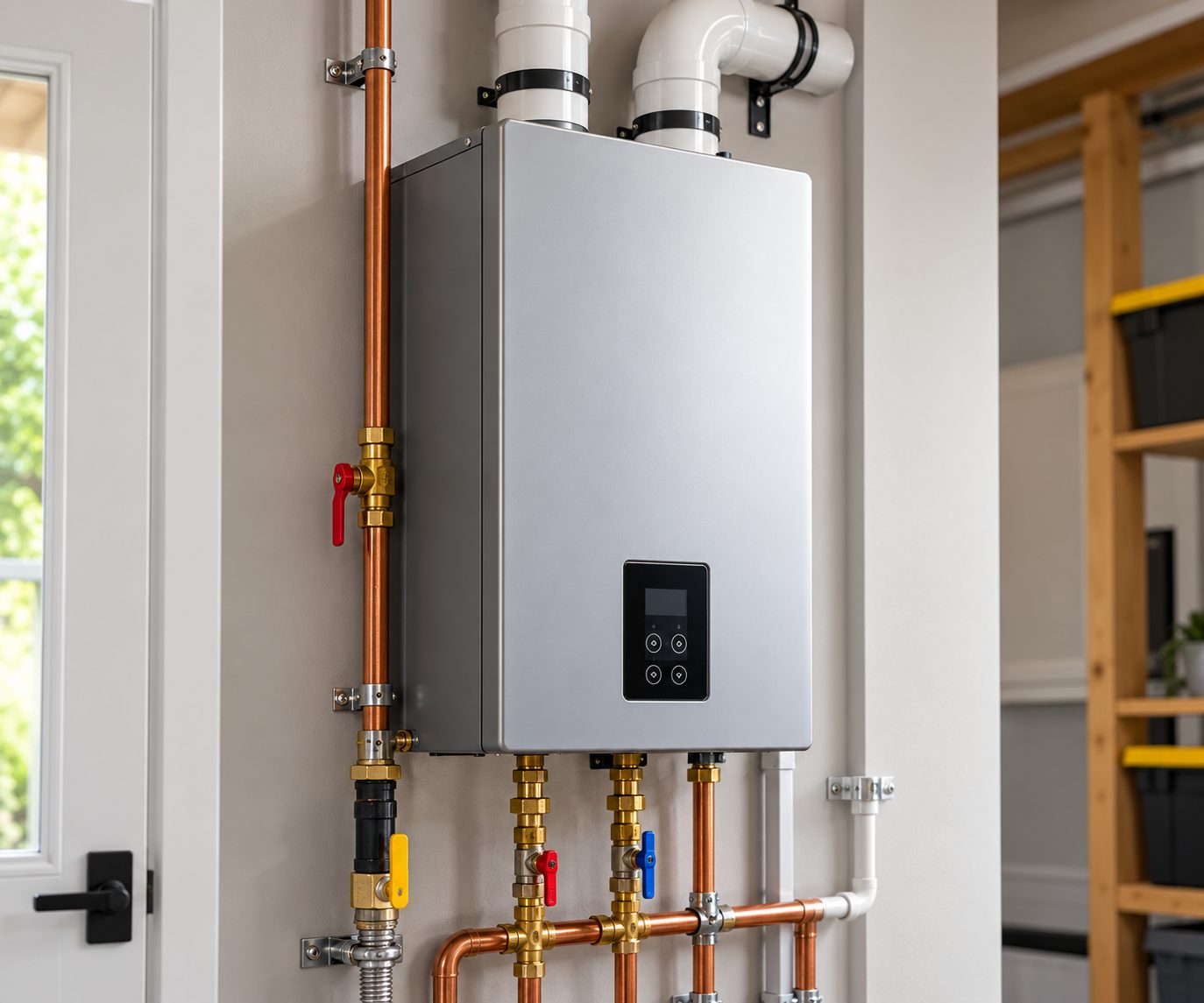
How it works
What is a tankless water heater?
A gas tankless water heater heats water as it flows through the unit, only when a hot water fixture is open. A storage-tank heater keeps a tank of water hot all the time, ready to use.
Tankless means continuous hot water, but only within the unit’s rated flow and temperature rise. Open too many fixtures at once, especially in winter, and the water will come out cooler or the flow will drop.
- Opening a hot tap starts water flowing through the unit.
- A flow sensor fires the burner.
- Water is heated as it passes through the heat exchanger.
- The burner stops when the tap closes. No tank of hot water is kept.
Why tankless
Benefits of tankless water heaters
Hot water on demand
Heats water as you use it, so there is no tank to run out of, up to its rated flow.
Compact wall-mounted design
Frees up the floor space a tank would take.
Reduced standby losses
No stored hot water sitting in a tank losing heat.
High-efficiency options
Condensing models recover extra heat from the exhaust.
Flexible applications
Suits many homes, from condos to larger houses with properly sized units.
Types
Non-condensing or condensing?
Which configuration suits your home depends on the venting route, drainage and gas supply available.
| Compare | Non-condensing | High-efficiency condensing |
|---|---|---|
| Efficiency | Lower (about 0.80–0.87 UEF) | Higher (about 0.92–0.97 UEF) |
| Venting | Exhaust is hot, so it needs approved stainless or special vent material | Exhaust is cooler, so it can usually vent through plastic pipe |
| Condensate | None | Needs a drain, and often a neutralizer |
| Installation complexity | Vent material and route can limit placement | Drain needed, but venting is often simpler |
| Maintenance | Descaling and annual service | Descaling, annual service and condensate checks |
Sizing
How big a tankless heater do you need?
Tankless capacity is measured as flow, in litres or gallons per minute, at a given temperature rise: how much the unit has to warm the incoming water.
Canadian water can arrive near freezing in winter, so a unit has to raise it much further than in summer and can supply less hot water at once. Showers, faucets, the laundry and the dishwasher each add to the flow needed. Homes with several bathrooms need the most capacity.
This guide is for understanding only. It is not a substitute for professional equipment selection.
Flow rates are typical figures. Your fixtures may use more or less.
- Hot water needed at once
- 11.5 L/min
- Unit can supply at 49 °C
- 17.6 L/min
This combination fits within the unit’s capacity in this season.
Capacity falls as incoming water gets colder, because each litre needs a bigger temperature rise. Based on a condensing unit at about 95% efficiency, heating to 49 °C. A professional sizing considers your actual fixtures and plumbing.
Running costs
What would tankless cost to run?
Based on your household’s hot water use and real standby losses. Tankless is not always cheaper to run, and this will show you when it isn’t.
That suggests about 150 litres of hot water a day. Change it under the assumptions if you know your use.
Adjust the assumptions
Incoming water is colder in winter, which raises the energy needed. The default is a yearly average for your province.
- Estimated current yearly water heating cost
- $166
- Estimated yearly cost with a new tankless
- $93
- Potential yearly savings
- $73
- Illustrative 10-year difference
- −$730
| Part | Now | New |
|---|---|---|
| Energy used | 519 m³ | 289 m³ |
| Water heating | $166 | $93 |
How this is worked out
- Hot water: about 150 litres a day, heated from 10 °C to 55 °C (about 2,865 kWh of heat a year).
- Efficiency is based on each system’s UEF rating. Storage tanks also lose heat while standing, which matters more when a household uses less hot water than the rating test assumes.
- Power-vent blowers, tankless electronics, fixed monthly charges and maintenance are not included.
- The 10-year figure is the yearly difference × 10 at today’s prices. It does not include equipment, installation, rebates or financing.
- This is an estimate, not a guarantee. Real use varies with household habits and the season.
Incentives
Tankless water heater rebates
Answer a few questions to see which programs you may qualify for. You do not need to give us any contact details.
Installation
Installation considerations
Gas supply
Tankless units can draw a lot of gas at once. The gas line, and sometimes the meter, must be sized for it.
Venting
An approved vent route through a wall or roof, with the right materials for the model.
Condensate drainage
Condensing models need a drain, often with a neutralizer.
Water pressure and flow
Enough flow is needed for the unit to fire, and pressure affects comfort at several fixtures.
Electrical
Most units need a standard outlet for their controls and fan.
Water quality
Hard water builds scale in the heat exchanger. A softener or scale protection may be recommended.
Maintenance and descaling
Plan on periodic descaling and annual service, more often with hard water.
How we work
The Nexhome installation process
Home consultation
We look at your current water heater, how your household uses hot water, and your gas supply, venting route and water quality.
Equipment recommendation
We recommend tankless options and sizes and explain what the installation involves.
Professional installation
Qualified installers complete the work, including gas, venting, condensate drainage and commissioning, to the applicable codes.
System walkthrough and support
We show you how the unit works and how to look after it, including descaling, and give you the warranty and support information that applies.
Comfort Today. Flexible Payment Options.
Explore financing options that may help make your home water heating upgrade more manageable.
Questions
Frequently asked questions
How does a tankless water heater work?
When you open a hot tap, water flowing through the unit triggers a burner that heats it as it passes through a heat exchanger. When the tap closes, the burner stops.
Can a tankless system run two showers simultaneously?
Often, if the unit is sized for it. Its capacity falls as incoming water gets colder, so a combination that works in summer may not in January. The sizing guide above shows how this works.
How much hot water can a tankless heater produce?
It produces hot water continuously, but only up to its rated flow at a given temperature rise. It does not store extra for a sudden peak.
Does tankless save energy?
It avoids the standby losses of a tank, and condensing models are very efficient. How much you save depends on what you are replacing, your gas price and how much hot water you use. Savings are often modest, and the calculator above shows an estimate.
How long does a tankless water heater typically last?
Many last 15 years or more with regular maintenance, which is often longer than a storage tank. Water quality affects lifespan.
Does a tankless heater require maintenance?
Yes. Periodic descaling and annual service are recommended, and condensing models also need their condensate drain checked.
Does hard water affect tankless systems?
Yes. Hard water builds scale inside the heat exchanger, which reduces performance. More frequent descaling or water treatment helps.
Can I replace my tank with a tankless heater?
Usually, but it may need a larger gas line, a new vent route, a drain and an outlet. If your current tank is rented, check your rental agreement’s terms for returning or buying out the tank first.
What rebates may be available?
None of the provincial programs we track currently offer a rebate for a gas tankless water heater. The checker above shows what is listed for your province.
Can I finance a tankless water heater?
Financing options may be available. See the financing section above or ask during your consultation.
Let’s Find the Right Water Heater for Your Home.
Our team can help you explore options, understand installation requirements, and choose a system suited to your household.