
Heating & Cooling · Central air conditioning
Stay Cool. Stay Comfortable.
Enjoy reliable, energy-efficient cooling through Canada’s hottest days. Discover central air conditioning options designed to keep your home comfortable all summer long.
How it works
What is central air conditioning?
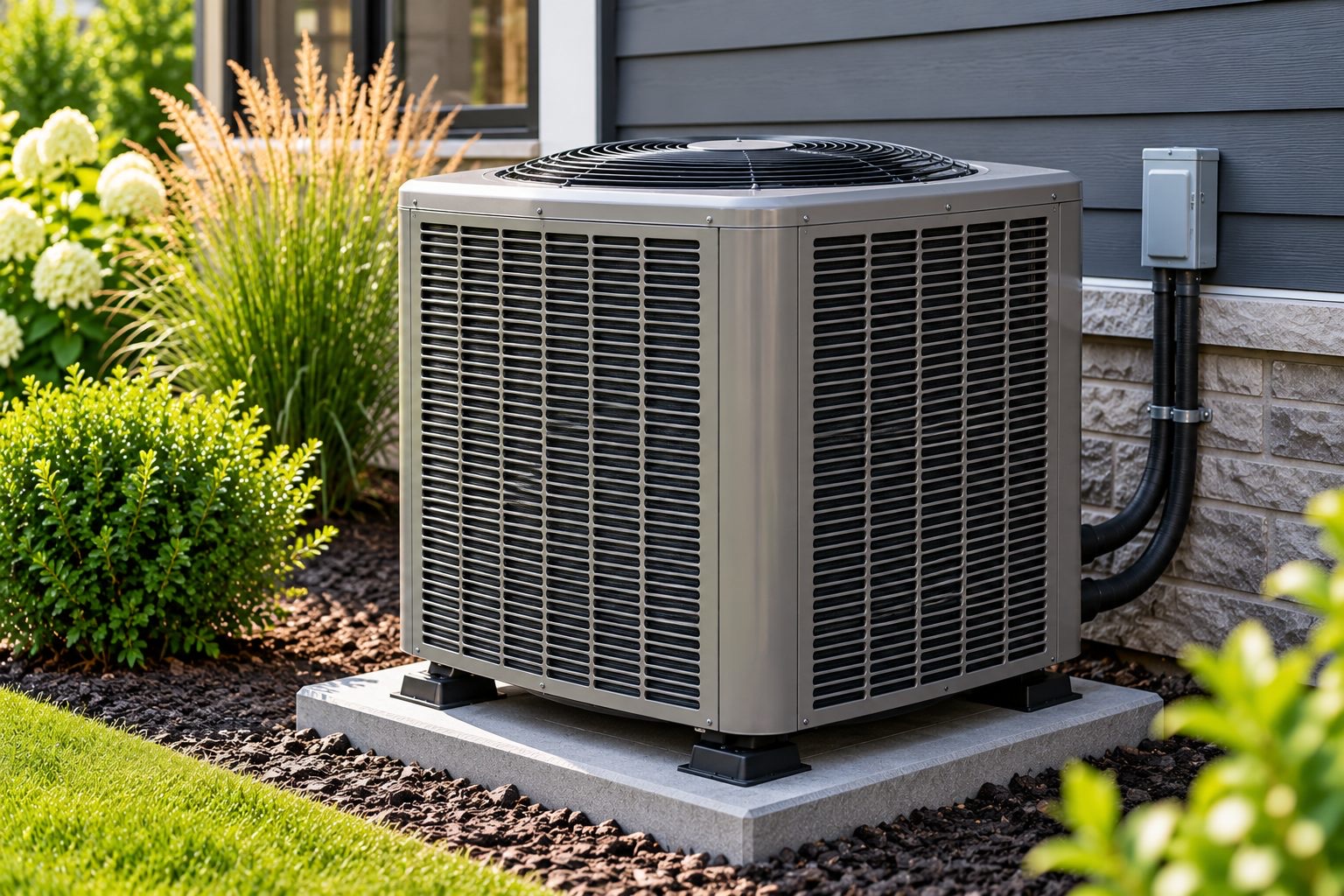
A central air conditioner removes heat and moisture from the air inside your home and releases that heat outdoors. It usually works with your existing furnace or an air handler, which moves the cooled air through the same ducts used for heating.
Outdoor condenser
Releases the heat taken from your home to the outside air.
Indoor evaporator coil
Sits on top of the furnace or air handler and absorbs heat and moisture from the air.
Refrigerant lines
Carry refrigerant between the indoor coil and the outdoor unit.
Furnace blower or air handler
Moves the air across the coil and through the ducts.
Thermostat
Tells the system when to run.
Ductwork
Delivers cooled air to each room and brings warm air back.
- Warm air from the rooms returns to the furnace or air handler.
- It passes over the cold indoor coil, which absorbs heat and moisture.
- Refrigerant lines carry that heat to the outdoor unit, which releases it outside.
- The blower sends the cooled, drier air back through the ducts. The thermostat runs the whole cycle.
Why central air
Benefits of central air conditioning
Whole-home cooling
Cooled air reaches every room through compatible ductwork.
Improved indoor comfort
Helps keep indoor temperatures comfortable through hot weather.
Humidity control
A properly sized and set-up system also removes moisture from the air.
Energy-efficient options
Modern equipment can be considerably more efficient than older systems.
Quiet, consistent operation
Some designs, especially variable-speed systems, can run more quietly and hold the temperature more evenly.
Performance varies with the equipment, how it is sized and installed, and the home.
AC types
Single-stage, two-stage or variable-speed?
The difference is how the compressor controls its output, which affects comfort, humidity and noise.
Single-stage
The compressor is either off or running at full output. Simple and proven, but it cools in full-power bursts.
Two-stage
Runs on a lower setting most of the time and steps up on the hottest days, for longer, gentler cycles.
Variable-speed
An inverter-driven compressor adjusts its output in small steps to match what the home needs.
| Compare | Single-stage | Two-stage | Variable-speed |
|---|---|---|---|
| Cooling performance | Full output whenever it runs | Low setting for mild days, high for heat waves | Matches output closely to the need |
| Humidity management | Short cycles can leave air feeling damp | Longer low-speed runs remove more moisture | Usually the best moisture removal |
| Noise | Noticeable when it starts at full output | Quieter on its low setting | Usually the quietest |
| Efficiency | Set mainly by its SEER2 rating | Often higher ratings available | Can reach the highest ratings |
| Equipment complexity | Fewest components | More controls | The most sophisticated electronics |
| Installation cost | Generally the lowest | Generally in between | Generally the highest |
Efficiency
Understanding cooling efficiency
SEER2 measures how much cooling a system delivers for the electricity it uses over a typical cooling season. EER2 measures the same thing at a single hot condition. Both come from standardized tests.
A higher SEER2 generally means more efficient seasonal cooling. It is not a percentage of savings, though. What you actually save depends on your climate, how the system is sized and installed, how much you use it, and your electricity price.
Ratings before 2023 used the older SEER test, which gives higher numbers for the same equipment. The chart converts them so the bars compare like with like.
- Older AC, about 10 SEER about 9.5 SEER2141
- Entry-level new AC 13.4 SEER2100
- Higher-efficiency 16 SEER284
- Premium variable-speed 20 SEER267
Same weather, same home, same thermostat. Real savings depend on how much you cool and what you pay for electricity.
Running costs
What could a new AC save?
An efficiency-based estimate. If you don’t know your cooling use, we estimate it and label the result as illustrative.
Home size only gives a rough figure for this estimate. It is not how an AC should be sized; that takes a cooling load calculation.
Adjust the assumptions
Cooling hours vary with weather, insulation, shade and thermostat settings. The default is a rough figure for your province.
Choose your system size or enter your home size to see an estimate.
Incentives
Explore available cooling incentives
Not every air conditioner qualifies for a rebate, and very few programs pay for a standard AC right now.
Answer a few questions to see which programs you may qualify for. You do not need to give us any contact details.
Replacing your air conditioner? Consider a heat pump.
A central heat pump can provide air conditioning during summer and heating during colder months. Depending on your home, equipment selection, and available programs, a heat pump may offer additional benefits and potential incentives. Eligibility depends on each program’s requirements and approved equipment.
Compare
Air conditioner or heat pump: which is right for your home?
A central air conditioner primarily cools and works alongside a separate heating system. A central heat pump cools and heats, and can be paired with an air handler or a compatible furnace. Neither is the better choice for every home.
| Compare | Central air conditioner | Central heat pump |
|---|---|---|
| Summer cooling | Yes | Yes, in the same way |
| Winter heating | No. Works alongside a separate heating system | Yes. Output falls as it gets colder |
| Existing furnace | Pairs with a compatible furnace for heating and air movement | Can pair with a compatible furnace (hybrid) or an air handler |
| Equipment efficiency | Rated for cooling (SEER2, EER2) | Rated for cooling (SEER2) and heating (HSPF2) |
| Installation | Outdoor unit, indoor coil and refrigerant lines | Similar, plus heating controls and possibly electrical work for backup heat |
| Government incentives | None currently listed for a standard AC | May qualify for heat pump programs, depending on the program and equipment |
| Operating costs | Cooling costs depend on SEER2, use and electricity rates | Similar cooling costs. Heating may cost more than natural gas, and often less than oil, propane or electric baseboard |
| Backup heating | Not applicable; your furnace is the heat | Needs backup heat for the coldest days: a furnace or electric heat |
Repair or replace
Is it time to replace your air conditioner?
Any of these is a reason to have the system looked at. None of them on its own means it has to be replaced, and age alone is not a reason.
Frequent breakdowns
Repeated service calls, especially for the same problem.
Inadequate cooling
The house no longer cools down on hot days.
Uneven temperatures
Some rooms stay warm while others are cold.
Rising electricity use
Summer bills climbing without a change in how you cool.
Unusual noises
Grinding, rattling or squealing from the outdoor unit.
Excessive cycling
The system turns on and off very often.
Refrigerant concerns
Leaks, or an older system that uses R-22, which is no longer produced and is increasingly costly to recharge.
High repair costs
A major repair quote on an older unit.
Aging equipment
Older systems are more likely to need repairs, though age alone does not mean replacement is needed.
Choosing an AC
Choosing the right air conditioner
The right system comes from a cooling load calculation for your home, not its square footage.
Cooling load calculation
How much heat the home gains on a hot day sets the size, not floor area alone.
Correct sizing
An oversized AC cools quickly but shuts off before it removes much moisture, leaving the house cool but clammy.
Existing ductwork
Ducts need to carry enough air for cooling, which often needs more airflow than heating.
Furnace or air handler
The blower must be able to move the right amount of air, and the indoor coil must match the outdoor unit.
Electrical requirements
The outdoor unit needs a dedicated circuit and disconnect sized for it.
Insulation
Attic insulation, windows and shading change how much cooling the home needs.
Airflow
Correct airflow across the coil is key to both efficiency and comfort.
Humidity control
Two-stage and variable-speed systems can remove more moisture on mild, humid days.
Refrigerant and installation
Newer systems use newer refrigerants, so an old outdoor unit usually can’t be paired with a new coil. Installation must be done by a licensed technician.
Equipment efficiency
Higher SEER2 uses less electricity for the same cooling.
How we work
The Nexhome AC installation process
Home consultation
We review your existing cooling system, your home and any comfort concerns.
Equipment recommendation
We explain suitable AC options, efficiency levels, and what the installation requires.
Professional installation
Qualified installers install and commission the system to the applicable codes and requirements.
System walkthrough and support
We explain the thermostat, basic maintenance, and the warranty and support information that applies.
Stay Comfortable With Flexible Payment Options.
Explore financing options that may help make your home cooling upgrade more manageable.
Questions
Frequently asked questions
How long does a central air conditioner typically last?
Many last 15 years or more. Lifespan depends on the equipment, how well it was installed, how much it runs, and how well it is maintained.
What size AC does my home need?
That comes from a cooling load calculation for your home, which looks at insulation, windows, sun exposure and layout. Square footage alone is not reliable, and an oversized AC can leave the house cool but humid.
What is the difference between SEER and SEER2?
Both measure seasonal cooling efficiency. SEER2 became the standard rating in 2023 and uses a test that better reflects real ductwork, so the same unit gets a lower SEER2 number than its old SEER number. For a typical ducted system, SEER2 is about 5% lower, so compare SEER with SEER and SEER2 with SEER2.
Is a higher-efficiency AC worth it?
It depends on how much you cool and what you pay for electricity. Cooling seasons are short in much of Canada, so the yearly saving from a premium rating is often modest. Variable-speed systems can still be worth it for quieter running and better humidity control. The calculator above gives an estimate for your situation.
Can I keep my existing furnace?
Often, yes, if its blower can move the right amount of air and it is in good condition. The indoor coil must also match the new outdoor unit. If the furnace is old, replacing both together can be worth considering.
Does a new AC require new ductwork?
Usually not. The ducts are checked during the assessment, because cooling can need more airflow than heating and undersized ducts can make a system noisy or less effective.
What is the difference between a central AC and a heat pump?
A central AC only cools. A heat pump cools the same way in summer and runs in reverse to heat in winter. See the comparison above and our central heat pump page for more.
Are government rebates available for air conditioners?
Very few programs currently pay a rebate for a standard central AC. Heat pumps, which also cool, may qualify for incentives depending on the program. The checker above shows what is listed for your province.
How much electricity does central AC use?
It depends on the system’s size and SEER2 rating, how many hours it runs, your home’s insulation and your thermostat setting. The calculator above estimates it for your home.
How long does installation take?
It depends on the scope, such as electrical work, a new indoor coil or duct changes. We give you a timeline for your project after assessing your home.
How often should an air conditioner be serviced?
Most manufacturers recommend professional maintenance once a year, ideally before the cooling season. Keep the outdoor unit clear of debris and change the furnace filter regularly.
Should I repair or replace my existing AC?
It depends on the unit’s age and condition, the repair cost, how reliable it has been, and the refrigerant it uses. An assessment gives you the facts to decide, and a repair is sometimes the better choice.
Let’s Find the Right Cooling System for Your Home.
Whether you’re replacing an older air conditioner or exploring a more energy-efficient solution, Nexhome can help you understand your options.